News Autumn reseeding: Hit the ground running in 2026
11 August 2025

Grassland expert Claire Bailey Archibald explains how autumn reseeding can give you a head start on 2026 grass and forage production.
For many farms, 2025 has been an excellent year for grass and forage growth. If you have strong winter silage stores, now is the ideal time to start preparing for autumn reseeding.
While spring reseeding is important, autumn is highly effective in good growth years. But timing is critical – aim to get seed in the ground by the first week of September. This will ensure:
- Moisture is less of an issue.
- Soil temperature is high enough for establishment.
- You can use a post-emergence spray before growth slows.
- Higher growth rates compared to the old sward.
- Simpler management: Full sward production from spring without disruption.
- A possible autumn grazing if ground conditions hold up.
Falling perennial ryegrass yields
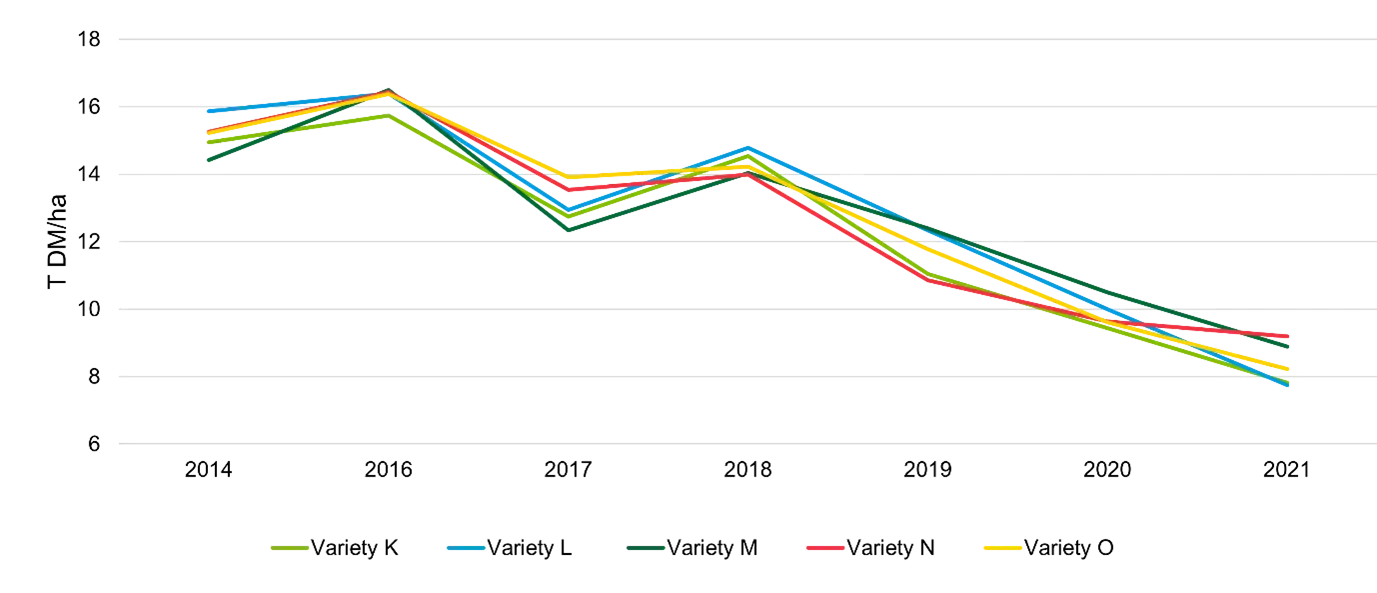
Swards ‘run out of steam’ over time. You’ll see a noticeable drop in production and often a higher weed burden. Research shows that after eight years, even well-managed perennial ryegrass yields can fall by up to 50%. This leaves you with an ever-increasing forage gap to plug as the years go by.
Change in DM yield of perennial ryegrass varieties over time
Source: David Lawson, SRUC
The chart shows how perennial ryegrass yields decline as a sward ages. Eight swards were studied over eight years in a trial conducted by Scotland’s Rural College (SRUC).
Strike early for greater success
With autumn reseeding, research shows it’s possible to nearly double your yield in spring if mixtures are sown by early September, compared to early October. While conditions might support later sowing, it’s better to be safe than sorry.
Effect of sowing date on sward establishment
| 3rd September | 4th October | |
| Seeds sown/m² | 1,030 | 1,030 |
| Seedlings six weeks later/m² | 760 | 570 |
| Tillers/m² in March | 7,190 | 3,110 |
| Kg DM/ha in March | 913 | 478 |
Source: Culleton et al 1992
Best practices for autumn reseeding
Before starting, remember that healthy soils and timely management will deliver the best results:
- Test fertility (target pH >6.5; P and K index of 3).
- Spray off the old sward and allow about three weeks for it to die off completely before cultivation.
- Use appropriate cultivation methods, ensuring a fine seedbed.
- Sow seeds at a depth of 10-15mm for effective establishment.
- Seed-to-soil contact is critical – ensure the field is rolled.
- Be cautious with direct drilling – it can increase slug risks, so good practice is essential.
Use highly rated varieties
On the 2025 PPI, Germinal’s Aber High Sugar Grass (HSG) varieties are among the highest options for yield and quality. While yield is essential to production, high-quality PRGs are better for digestibility, enabling stock to utilise more protein.
Aber HSG varieties are bred with higher sugar content compared to conventional grasses. This means that ruminant livestock grazing Aber HSG swards have a higher energy intake, enabling them to capture more protein from grass.
This results in less nitrogen being excreted and converted into nitrous oxide and ammonia. With less protein wasted, this drives up to 6% higher milk production and up to 20% higher liveweight gain.
Looking ahead with Climate Smart choices
The highest Aber HSG concentrations are found in our brand-new Climate Smart mixture ranges. Developed for performance plus sustainability, the ranges target five environmental challenges impacting grassland farmers:
Click any of the ranges to explore your mixture options. Each range also has a store locator to help you find your nearest Germinal stockist. You can also contact our grassland experts to talk through your options.
Tags