Guides How to sow white clover seed in pasture
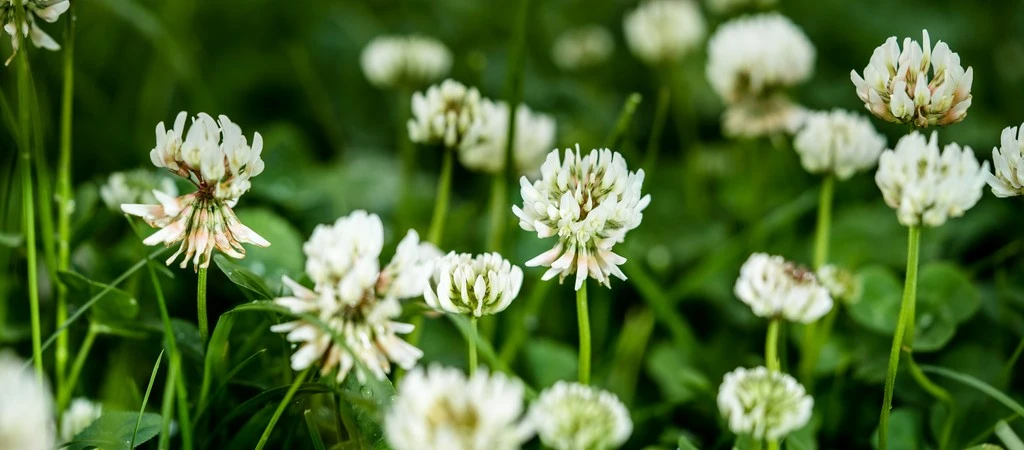
Are you making the most of white clover? This perennial, low-growing forage legume can lift your livestock production while supporting the environment. Using our guide, you can maximise the sustainable production potential of white clover in your grassland system.
Contents
1. White clover benefits: What does it bring to grassland?
- High in protein
- Improves grazing quality
- Increases dry matter (DM) intake in summer and autumn.
- Increases milk production and liveweight gain.
- Fixes atmospheric nitrogen and shares it for plant growth.
- Can reduce your reliance on nitrogen fertiliser.
- Enhances soil structure and fertility.
- Supports pollinators
2. How does white clover grow?
Stolons are multi-branched creeping stems and are key to the survival and production of white clover. These stems provide sites for new leaves, roots, and flowers. Stolons will store carbohydrates and proteins, enabling the white clover plant to overwinter and regenerate in spring.
White clover varieties (Trifolium repens) vary in leaf and stolon characteristics. The differences in leaf size can be significant and determine agronomic performance, as explained later.
The root system of white clover can improve soil structure and ease soil compaction. Studies at the Institute of Biological, Environmental and Rural Sciences (IBERS) found improved soil structure from higher white clover content in swards, resulting in these benefits:
- White clover has been proven to significantly decrease soil density and increase porosity.
- Nutrient uptake was improved and herbage production increased.
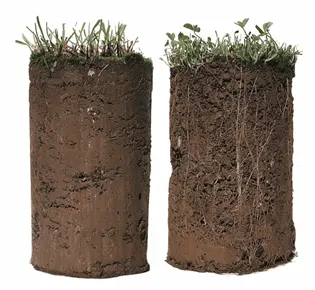
Image: Left root column with grass only; right root column with grass and clover.
3. Nitrogen fixation in clover
Nitrogen fixation is a biological process in which atmospheric N2 is converted into forms that can be used by clover plants. Rhizobia bacteria colonise the root nodules of clover, then take nitrogen as ammonium from the air and convert it into a plant-available form. The nitrogen becomes available for companion grasses as it’s released following plant decay.
Swards with an average white clover content of 25-30% across the year can fix around 150kg N/ha annually from the atmosphere, sharing surplus N with surrounding plants. The exact amount fixed depends on:
- White clover content of swards: More nitrogen is fixed as clover content increases.
- Nitrogen fertiliser application rate: Less nitrogen is fixed if more artificial nitrogen is applied.
- Soil temperature: The rate of nitrogen fixation increases as the soil temperature rises, with 8°C and above needed for fixation to start. The optimum fixation is then reached above 15°C, with fixation declining at temperatures above 25°C.
4. White clover growth stages
Rosette Phase
- Approximately 0-3 months post-sowing.
- Reliant on the central taproot.
- Few stolons
- Small spread
- No nitrogen fixation
- Important to graze to promote growth.
Expansion phase
- 3-6 months post-sowing.
- Still reliant on the central taproot.
- Rapid expansion of up to 15 stolons, around 25-30cm in length.
- Initial rooting of the stolons is poor, so graze carefully to avoid damage.
Clonal phase
- Reliant on adventitious roots forming on the nodes of stolons
- Stolons last for 12-18 months with the cycle repeating each year.
- New stolons are produced at the terminal bud and grow into independent plants.
- Good grazing management helps maintain stolon production and persistence in grazing swards.
- Active nitrogen fixation occurs.
Source: Teagasc
5. White clover leaf size: Why it matters
Small leaf
- More persistent
- Lower yielding
- Tolerant of tight grazing (e.g. sheep grazing).
Medium leaf
- Intermediate for yield and persistency.
- Suitable for dairy and beef grazing.
Large leaf
- Higher yielding
- Aggressive and can dominate swards.
- Suitable for silage swards.
- Less persistent
6. Supporting livestock performance
White clover is a forage crop that’s high in quality and digestibility, driving improved livestock feed intakes and performance. Below, we explore a few standout trials that support this.
Metabolisable energy (ME) and crude protein (CP): Early, mid, and late season
Using Germinal Horizon research, this table shows how clover provides high protein levels that build across the season. It also offers valuable ME when grass growth slows in summer.
| Species | Early season | Mid-season | Late season | |||
| ME (MJ/kg) | CP (%) | ME (MJ/kg) | CP (%) | ME (MJ/kg) | CP (%) | |
| Perennial ryegrass | 11.43 | 13.99 | 10.79 | 12.13 | 11.22 | 16.34 |
| White clover monoculture | 11.65 | 25.17 | 11.01 | 20.51 | 11.77 | 23.52 |
Source: Germinal Horizon, 2023
Feed value: Perennial ryegrass vs clover
And when combining perennial ryegrass with white clover, you can see below how a mixed sward can outperform a monoculture for total dry matter (DM). In a four-year research trial at Germinal Horizon Wiltshire, the average annual yield was 24.29% higher for perennial ryegrass and white clover.
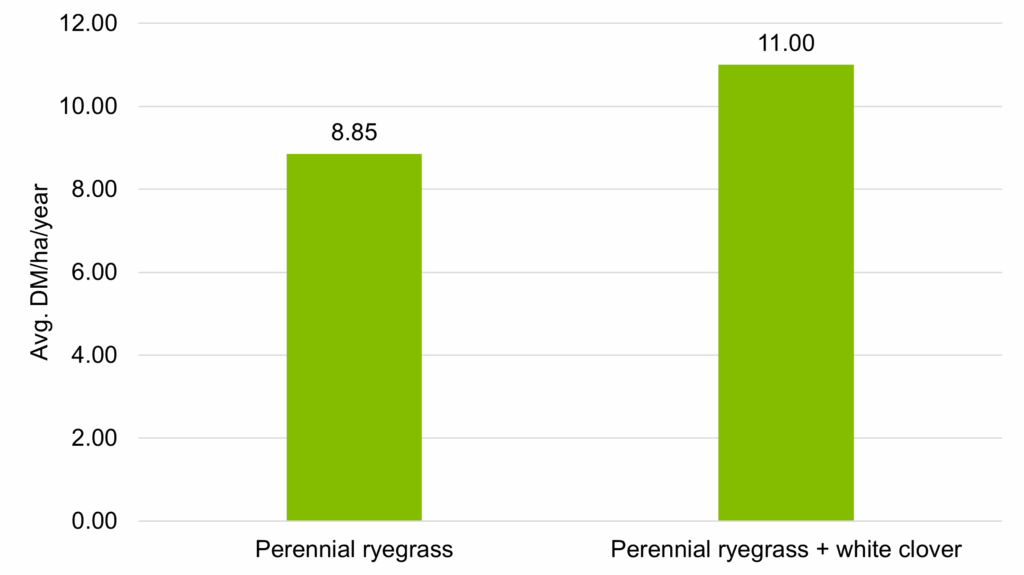
Source: Germinal Horizon, 2020-23
Milk production
For dairy systems, grass-clover swards have the potential to lift performance. This is backed by a Teagasc grazing experiment at its Moorepark site. Higher performance for milk yields, fat content, protein content, and milk solids was recorded for perennial ryegrass and white clover at 150kg N/ha and 100kg N/ha versus perennial ryegrass only at 200kg N/ha.
| Grass only (200kg N/ha) | Grass-clover 19.8% (150kg N/ha) | Grass-clover 20.1% (100kg N/ha) | |
| Milk yield (kg/cow) | 5,650 | 5,881 | 5,878 |
| Fat content | 5.16% | 5.30% | 5.36% |
| Protein content | 3.70% | 3.73% | 3.76% |
| Milk solids yield (kg/cow) | 504 | 534 | 537 |
Source: Teagasc, 2023-24
Meat production
A study at Teagasc Grange (2023/24) shows the production potential for beef systems. After grazing only grass, heifers and steers were fed grass silage and 1.5kg of concentrate per day when housed.
Meanwhile, the grass-clover groups grazed grass and white clover, followed by red clover silage when housed. For both heifers and steers, the grass-clover groups generated higher carcass value.
| Heifers | Steers | Mean difference: Grass vs grass-clover | |||
| Carcass traits | Grass-only | Grass-clover | Grass-only | Grass-clover | |
| Final live weight | 571 | 592 | 598 | 630 | 27kg |
| Carcass weight | 299 | 308 | 313 | 340 | 18kg |
| Fat score (1-15) | 3= | 3= | 2+ | 3- | Similar |
| Carcass value at €5/kg | 1,605 | 1,669 | 1,647 | 1,809 | €113 |
Source: Teagasc, 2023/24
7. Advice: How to sow white clover
Seedbed: Soil fertility
A clean, fine, and firm seedbed is essential and should ideally be rolled before sowing. Your optimum soil pH is 6.5 for clover swards but 6.3 for mineral soils. On high molybdenum soils, don’t exceed pH 6.2.
An up-to-date soil test will indicate the soil fertility of the field. Aim to maintain optimum Index 3 for P and K (Index 2 in NI).
When to sow: Spring or autumn?
Germinal recommends sowing white clover in a full reseed from April until mid-August when soil temperatures are on your side (+8°C or higher).
After mid-August, establishing white clover can be more challenging in autumn conditions. April is the ideal time for overseeding white clover seed.
Clover requirements for ROI farms
All new perennial ryegrass (Lolium perenne) reseeds on Irish farms must now incorporate at least 1.5kg/ha (0.6kg/acre) of naked clover seed.
This requirement originally applied to Nitrates Derogation farmers and was extended to all others in the interim review of the 5th Nitrates Action Programme. This extension took legal effect on 25th February 2025 through an amendment to the Nitrates Regulations under SI No. 42 of 2025.
Reseeding: Seed rate and sowing depth
You can sow with perennial ryegrass by broadcasting or drilling in a full reseed. If drilling, the optimum sowing depth for white clover seed is 5-10mm. Don’t sow any deeper as the seeds are small and will struggle to establish if buried too deep.
Mixtures should contain 2-5kg/ha (0.75-2.0kg/acre), depending on environmental conditions, to achieve the desired levels of clover required.
Find our full grassland reseeding guide here.
Overseeding white clover: How to make it work
While a full reseed is most effective, if you’re overseeding into existing swards, give it the best chance of establishment:
- Be targeted and select fields with a high proportion of perennial ryegrass and with good soil pH (>6.2) and P and K index 3. Optimum fertility improves your chance of success.
- Start by controlling weeds. Check the herbicide residue period – it could be up to four months before clover can be oversown safely. This might need to be done a year before sowing clover.
- April is the best time for overseeding white clover. But not if dry weather is forecast – moisture is vital for germination.
- Take a silage cut or graze tightly and remove any grass thatch to give good soil visibility and soil-to-seed contact.
- Overseed at 2.5-4.0kg clover/acre.
- Clover can be broadcast with a fertiliser spreader or stitched in.
- If broadcasting, mix white clover seed with 1 bag of 0:7:30 per acre.
- Add the clover to the spreader in the field to avoid the seed settling at the bottom and giving an uneven spread.
- Clover seed doesn’t throw as far as fertiliser, so spread at half rate in two directions – up and down, then across the field. Only do around 1ha at a time before adding more clover and fertiliser to the spinner.
- Grazing the sward often helps light reach the clover seedlings, which is essential for their establishment. The first grazing should be taken at a pre-grazing herbage mass of 800kg DM/ha. Take the next grazings at around 1,000 kg DM/ha.
- Don’t overseed too much ground at once, as the lower pre-grazing herbage mass makes management more challenging. Only do around 10-15% of the land area in a year.
- Don’t cut silage in the year after overseeding. Maintaining light to the clover plants is essential.
- Aim to close any reseeded and overseeded clover fields as late in autumn as possible to minimise the amount of herbage carried over winter.
8. Grazing white clover: Timing matters
Spring
- Target early spring grazing to kickstart clover growth.
- Avoid poaching or damaging swards.
- Be flexible by using on-off grazing and target wetter paddocks in drier weather.
- Aim for a 3.5cm post-grazing sward height.
Mid-season (April to August)
- Maintain a pre-grazing cover of 1,300-1,500kg DM/ha and a pre-grazing height of 8-10cm.
- Target post-grazing sward height of 4cm.
- Reduce N fertiliser on swards with more than 25% clover. You can compare with the image below to assess your percentage.
Autumn
- Extend your rotation length to build grass covers from early to mid-August.
- Close your farm in rotation from early October.
- Target post-grazing sward height of 3.5-4.0cm on the final rotation.
- Avoid poaching or damaging swards.
- Be flexible by using on-off grazing.
- Close fields where you wish to encourage clover content towards the end of your final rotation.
Bloat risk
Bloat is the excessive build-up of gas (carbon dioxide and methane) in the rumen, produced by the rapid breakdown of clover protein. This causes distress and possible death due to the exertion of pressure on the animal’s diaphragm, heart and lungs.
Some legumes, including white clover, present an increased bloat risk in cattle. While the risk is always present in high clover swards, and further heightened in late summer and early autumn on damp days, you can minimise the risks of bloat by adopting these best practices:
- Limiting access to clover swards when stock are first introduced. For example, by using a breakfast break that forces the animals to graze grass with fibre.
- Avoiding turnout of hungry stock onto high clover fields
- Feeding high dry matter forage such as hay/straw before turnout.
- Offering hay/straw at intervals (for example, to dairy cows at milking times).
- Administering an anti-bloat treatment to livestock (for example, bloat oil in the water).
- In high-risk periods, check livestock often following turnout. Treat animals immediately where necessary.
9. How to manage white clover swards
Grass-clover balance
Maintaining an optimum dry matter balance of 25-30% white clover to 70% perennial grass as an average across the season is the key to grass-clover management. This will maximise clover’s nutritional and nitrogen-fixing attributes alongside high-yielding grass.
Dominance
The proportion of white clover in a sward is often visually overestimated. However, if it does become dominant and very little grass is visible, it can outcompete and unbalance your swards. Consider these actions if clover dominance is a major issue:
- Avoid using large leaf clovers in grazing swards.
- Tactical application of nitrogen to enhance grass growth.
Fertiliser
In early spring, clover won’t fix adequate nitrogen until soil temperatures improve. So, until May, it’s generally advised to apply N fertiliser as you would for grass-only fields.
If you can establish 25% clover in swards, N fertiliser can be reduced or eliminated. Sufficient clover is needed before N applications are reduced, or else the grass plant will not receive adequate N and growth will be impacted.
Sulphur is another important nutrient for grass and clover swards. Generally, 20kg S/ha per year is needed, applied a ‘little and often’ from March or April to June.
Other macro- and micro-nutrients are needed for white clover to establish and start fixing nitrogen. With soil testing, you can learn which nutrients are low and then precisely target your fertiliser applications. Fertile soil contains major nutrients, secondary nutrients, and trace elements to support plant nutrition.
| Major nutrients | Secondary nutrients | Trace elements |
| Nitrogen (N) | Calcium (Ca) | Iron (Fe) |
| Manganese (Mn) | ||
| Phosphorus (P) | Magnesium (Mg) | Zinc (Zn) |
| Copper (Cu) | ||
| Potassium (K) | Sulphur (S) | Boron (B) |
| Molybdenum (Mo) |
Pests to watch for
- Slugs: Potentially devastating in problem areas, particularly in drilled crops.
- Leatherjackets: Can be a significant pest after reseeding and have the potential to devastate new reseeds.
- Stem eelworm: Causes distortion of growing buds and young leaves and death of the plant.
- Sitona weevil: More common close to arable areas and leads to the removal of small semi-circular sections of leaflets.
Diseases
The most common disease affecting white clover is clover rot (Sclerotinia). This causes a generalised rot of the plant. Germinal white clover varieties are bred with stem nematode resistance.
Weeds
A clean seedbed is essential to avoid competition from weed species during establishment. A clover-safe spray is advised when the new reseed emerges – approximately six weeks post-sowing to control seedling weeds. Always follow the label advice and apply when conditions are suitable.
Find more advice on grassland weed control here.
The natural nitrogen maker
Want to do more with white clover? You can find it in multiple mixtures across our Climate Smart ranges. Offering performance plus sustainability, these mixtures have been expertly formulated to give you the best of both, with no compromise on production.
Share article