Guides How to sow red clover seed in pasture
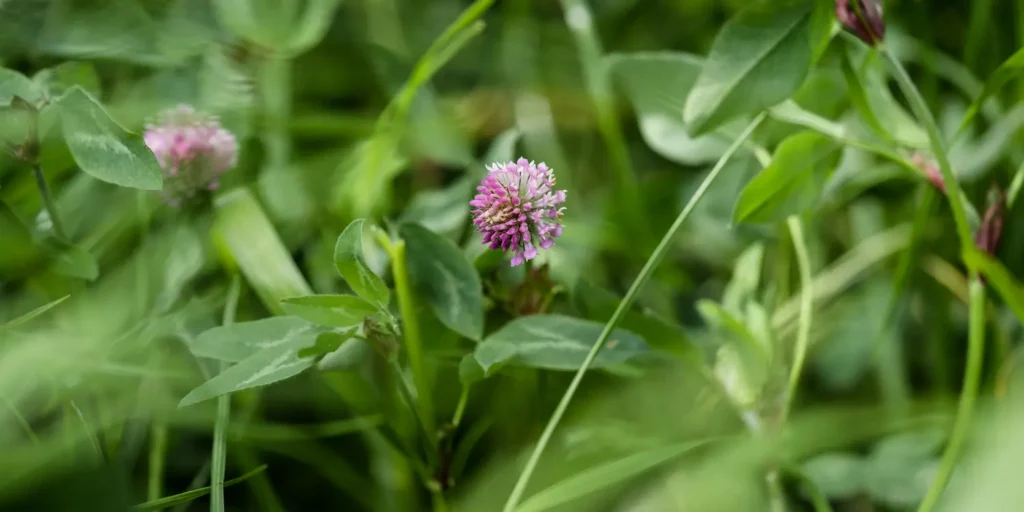
Rising input costs, changing markets, and environmental challenges are making Irish livestock farming more challenging than ever. But by sowing red clover seed, you can produce a high-quality, cost-effective source of homegrown protein to reduce your reliance on bought-in feed.
When your red clover swards are established, they can fix up to 200kg of atmospheric nitrogen per hectare each year. That nitrogen is then shared with companion grasses and reduces your need for artificial nitrogen fertiliser. This doesn’t just benefit your pocket, but also the environment.
This guide can either help you get started with red clover or strengthen your knowledge of establishing and managing this sustainable forage crop.
Contents
- Red clover benefits
- How does red clover grow?
- Understanding red clover
- Sowing advice
- Supporting livestock performance
- Managing red clover
1. Red clover: What are the benefits for grassland farming?
- Improved soil health – it can improve soil structure and fertility. The high nutrient content also makes it effective for break cropping or green manure.
- Nitrogen fixation – red clover naturally ‘fixes’ atmospheric nitrogen, supporting nearby plants. Established swards can fix around 200kg N/ha each year.
- High-yielding – sown with perennial ryegrass, yields of 12-15t DM/ha are achievable with no artificial N.
- High feed value – rich in protein (16-20%) and minerals, it supports excellent livestock performance with a reduced need for bought-in feed.
- High intake – it’s very palatable, encouraging higher intakes and increased liveweight gains and milk yields.
- Herd health – the high mineral content supports animal health.
2. How does red clover grow?
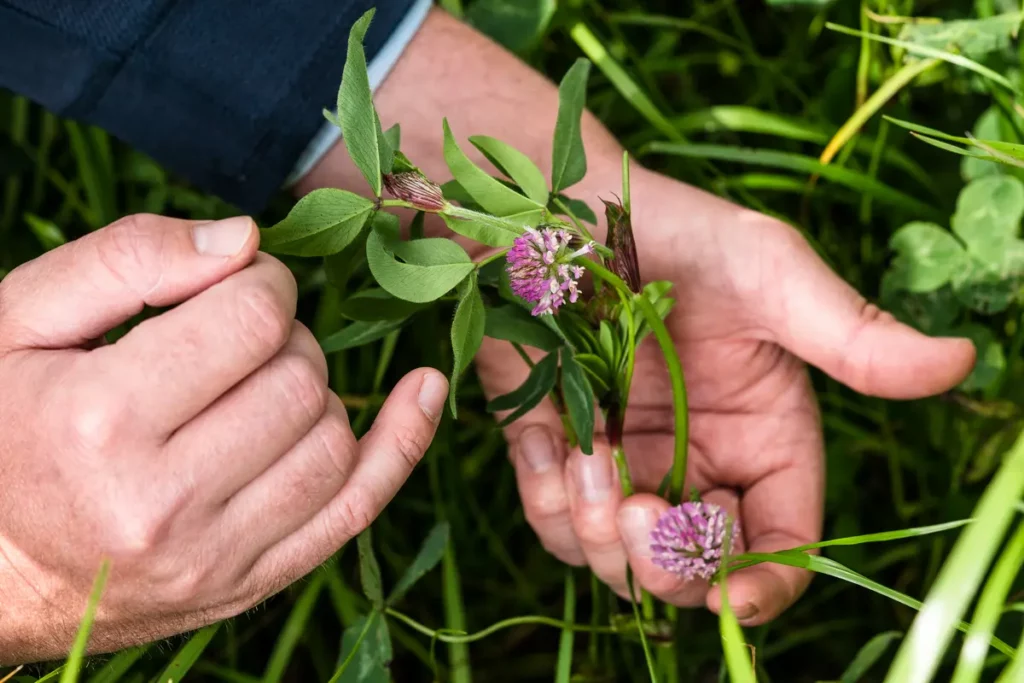
Red clover (Trifolium pratense) is a perennial herbage legume that typically persists for three to four years. Growing with an upright form and a strong, deep taproot from which finer roots arise, it’s very different to white clover.
The crown, located at the base of the stem, acts as a store of nutrients. Differences in the size and reserve status of the crown affect persistence and suitability for particular management regimes.
Red clover has a different growth profile compared to white clover. The plant grows from the crown at the base of the stem, where it stores nutrients for the plant.
Be mindful of larger crowns as they can be more easily damaged than smaller ones. Avoiding damage to the crown is vital to ensure crop persistence. It’s also important to highlight that the deep taproot acts as a nutrient pump, making it suitable for deep, fertile soils.
While red clover can be grown as a monoculture, it’s more commonly sown with perennial or hybrid ryegrass to produce high yields of protein-rich forage for conservation.
The development of more grazing-tolerant and persistent varieties is creating the potential for red clover in rotational grazing systems, and it’s also valuable as a break crop in cereal rotations because it can improve soil structure and fertility.
3. Understanding red clover
Nitrogen fixation
Nitrogen fixation is a biological process in which atmospheric N2 is converted into forms that can be used by clover plants. Rhizobia bacteria colonise the root nodules of clover, then take nitrogen as ammonium from the air and convert it into a plant-available form. The nitrogen becomes available for companion grasses as it’s released following plant decay.
Red clover plants can start fixing nitrogen from approximately six weeks post-sowing if the soil and environmental conditions are suitable. This gives you the benefits of nitrogen fixation much earlier compared to white clover.
Persistence
While red clover offers little winter growth, it tolerates cold and has good drought tolerance. It’s generally expected to have a lifespan of three to four years in swards, depending on management.
But that’s improving thanks to the plant breeding work of Germinal Horizon, who are working on a new generation of red clovers with longer lifespans and stronger persistence.
Varieties like AberClaret are more tolerant of grazing, making them suitable for use in rotational grazing systems. AberClaret can persist for four to five years under cutting, producing over 14.6t DM/ha in year four. It is also significantly more tolerant of grazing by dairy cattle.
4. Advice: How to sow red clover seed
Best sown in a full reseed from April to late July in well-drained, fertile soils, red clover seed works well with perennial ryegrass:
- Soil test, targeting pH 6.5 and Index 3 for P & K.
- Spray off the old sward with glyphosate.
- Apply lime as required to correct soil pH.
- Create a fine, firm seedbed to ensure good soil-to-seed contact.
- Ensure seedlings have sufficient energy to emerge by sowing seed no deeper than 10mm.
- Apply P and K in line with soil test results – fertiliser N is generally not necessary.
- Apply a clover-safe weed spray according to label requirements approximately 5-6 weeks after establishment.
- A light conservation cut can be taken in the first sowing year, depending on the sowing date.
- Graze swards lightly in autumn of the sowing year. Avoid grazing in wet weather when the crown is more susceptible to damage.
Please note: We cannot recommend overseeding red clover into an existing sward, due to the potential risks of sclerotinia and steel eelworm.
5. Supporting livestock performance
Forage production
In a six-year experiment, Clavin et al (2017) found that combining red clover and perennial ryegrass produced a slightly higher annual yield on average compared to perennial ryegrass only.
This is impactful for forage production because no applied nitrogen was used on perennial ryegrass and red clover. Meanwhile, the perennial ryegrass-only swards required 412kg N/ha/year.
| Harvest | PRG (kg DM/ha) | PRG+RC (kg DM/ha) |
| First cut | 6,683 | 6,364 |
| Second cut | 3,610 | 4,459 |
| Third cut | 3,222 | 3,847 |
| Fourth cut | 2,183 | 1,115 |
| Total | 15,698 | 15,785 |
Source: Clavin et al, 2017
Liveweight performance
Dairy-beef weanlings: Perennial ryegrass silage vs red clover
As for liveweight gain, a trial examining dairy-beef weaning performance in the first winter comparing perennial ryegrass silage to red clover silage demonstrated a 10 kg increase in liveweight gain over the winter period with weanlings offered the red clover silage.
| Growth performance | Perennial ryegrass silage | Red clover silage |
| Dry matter intake (kg DM) | 6.2 | 7.6 |
| Residual feed intake (kg DM) | 0.14 | 0.15 |
| Initial liveweight (kg) | 286 | 286 |
| Final liveweight (kg) | 337 | 346 |
| Average daily gain (Kg) | 0.56 | 0.68 |
Source: Teagasc (May, 2025)
Lamb: Grazing perennial ryegrass vs red clover
A study by Woodmartin et al (2024) compared the production performance of grazing lambs when a companion forage is grown with perennial ryegrass. When including red clover, there were significant improvements in two key metrics:
- Average daily gain (g) – 67.27% increase
- Days to slaughter – 50 days quicker
Managed correctly, red clover can be used to significantly speed up lamb production.
| Growth performance | Perennial ryegrass | Perennial ryegrass and red clover |
| Weaning weight (kg) | 30.7 | 29.5 |
| Average daily gain (g) | 110 | 184 |
| Days to slaughter | 249 | 199 |
| Slaughter weight | 45.7 | 46.3 |
Source: Woodmartin et al (2024)
Bloat risk
If you’re new to red clover or want to grow more, it’s important that you’re aware of and ready to minimise bloat risk.
An excessive buildup of carbon dioxide and methane gases in the rumen, bloat causes distress and possible death for grazing livestock. This is due the exertion of pressure on the animal’s diaphragm, heart, and lungs.
Legumes such as clover present an increased risk of causing bloat because of the rapid breakdown of protein in the rumen if not safely managed.
Effective management to minimise bloat risk in livestock grazing clover-dense swards should include:
- Limiting access to swards when stock is first introduced (e.g. have a breakfast break).
- Avoiding turnout of hungry stock.
- Feeding high dry matter forage such as hay/straw prior to turnout.
- Offering hay/straw at intervals (e.g. to dairy cows at milking times).
- Feeding an anti-bloat feed additive.
- Monitoring livestock
6. How to manage red clover
Cutting and grazing heights
As the crown is above ground, damage must be avoided to ensure plant survival:
- Cutting height for all silage cuts should be 7-8cm.
- Optimum grazing height of aftermaths or over winter is 4-6cm.
- In wet weather, avoid heavy machinery and poaching.
Red clover silage
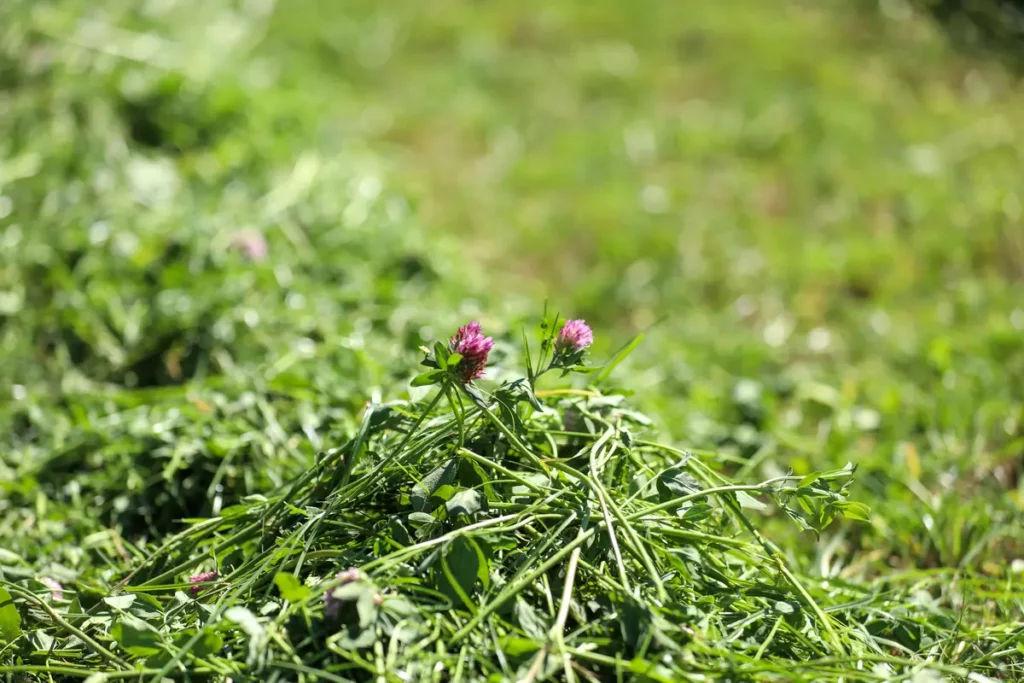
Intermediate or late-heading perennial ryegrasses are ideal companion grasses for conventionally cut red clover seed mixtures. It’s relatively low in sugar, also referred to as water-soluble carbohydrates. Therefore, using grasses with a high water-soluble carbohydrate content increases overall energy levels and improves the ensiling process.
- For optimum quality, cut three to four times per year. Target your first cut a week before the heading date of the grass. From there, target 6- to 8-week intervals to a height of 7-8cm.
- Leaves are prone to shatter, so disengage the mower conditioner and avoid excessive handling of the mown crop.
- It’s low in dry matter (DM), so a good wilt is essential. Wilt for up to 48 hours, aiming to ensile at 25-30% DM.
- While artificial N is unnecessary in established red clover, it’s important to apply adequate P and K to maintain soil at an index 3 and allow for offtakes of the crop. A 15-tonne crop requires 375kg potassium (K) per hectare (300 units/acre).
Aftermath grazing
Excellent for aftermath grazing for sheep, lamb growth rates are particularly good from red clover and ryegrass compared with a ryegrass monoculture.
It can also be combined effectively with white clover, chicory, plantain, and other herbs and legumes in multi-species swards for an outstanding lamb finishing mixture.
- A light grazing in the autumn is acceptable.
- Introduce slowly and then retain as a consistent component of the diet, avoiding daily fluctuations in the quality and quantity offered.
- To reduce bloat risk, avoid grazing with hungry stock or in wet conditions. Never allow stock to gorge themselves on clover-rich pastures.
- Feed roughage, such as straw or hay, before turning out and, if necessary, during grazing.
- Affected animals can be treated with anti-foaming agents or, in severe cases, remove animals from clover swards and seek veterinary advice.
- Red clover can contain up to 1% of oestrogenic compounds. Avoid grazing with breeding ewes and rams six weeks either side of breeding as the phytoestrogen content can reduce conception rate.
- Store lambs can be offered red clover swards and silage at any time and reports of it affecting cattle fertility are rare.
- Minimise poaching as it reduces crop persistency.
You can find out more on other popular grazing systems in this article.
Combating pests and diseases
- Slugs can be problematic in drilled crops, particularly when there’s residual from the previous crop. They should be controlled to avoid damage during establishment.
- Clover rot (Sclerotinia) is the most important disease to watch for. This fungal disease, often seen in December and January, causes a generalised rot of the crown, leaves, and stems from which plants rarely recover. Clover rot cannot usually be controlled safely or economically in situ and a five-to-seven-year rotation is strongly recommended.
- Stem eelworm is the most concerning pest and the most effective control is rotation. Ensure a five-year break between red clover crops to reduce the risk of soil-borne pests and diseases and extend to seven years if clover rot or stem eelworm is present.
- Crown and root rot (typically caused by Fusarium) and powdery mildew can also impact but are less devastating.
There are limited clover-safe agrochemicals for the prevention of pest and disease problems in clover, which is why planning and crop rotations are so important. Products should only be used following advice from a qualified agronomist.
Weed control
A clean seedbed is essential to avoid competition from weed species during establishment. While most annual and some perennial weeds can be controlled by regular pasture topping, you might need to use herbicides in the most difficult circumstances.
In this case, ensure a clover-safe product is used and follow the recommendations specifically for red clover. You can find more detailed advice on grassland weed control here.
The natural nitrogen maker
Want to do more with red clover? You can find it in multiple mixtures across our Climate Smart ranges. Offering performance plus sustainability, these mixtures have been expertly formulated to give you the best of both, with no compromise on production.
Share article