Guides Using multi-species swards for sustainable livestock production
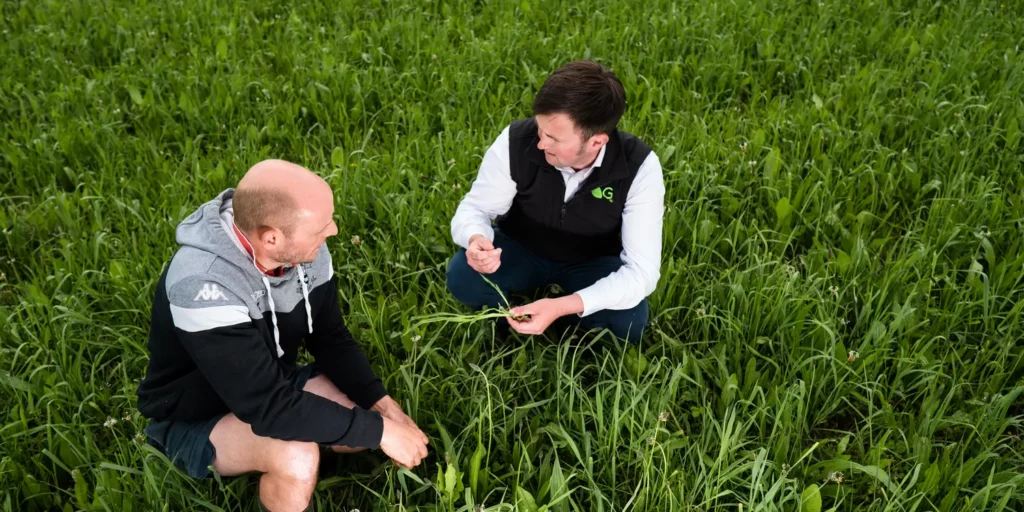
Are you growing multi-species swards already, or wondering where to begin? This in-depth guide can build your knowledge and share best practices to support your sowing, management, and feeding of multi-species to ruminant livestock.
Contents
- What are multi-species swards?
- What are the benefits?
- How can multi-species be used?
- Which species do I need?
- Maximising performance
- Sowing advice
- Managing multi-species
1. What are they?
Multi-species swards contain three or more species from grasses, legumes, and herbs. Also known as herbal leys, these diverse swards provide multiple sources of protein, energy, and minerals for ruminant livestock.
The different forages have complementary growth habits and sward performance can be better than monoculture swards, as each species brings specific advantages. This has been found in several major studies, as shown in the Performance section of our guide.
2. What are the benefits of multi-species swards?
Livestock performance
- Suitable for dairy, beef, or sheep systems.
- High digestibility increases dry matter intakes.
- Better overall nutritional profile compared with grass only.
- Boost in mid-season and autumn production.
- Greater daily liveweight gain in livestock.
- Anthelmintic properties in herbs reduce worm burden in stock.
Soil health and the environment
- Nitrogen fixation from legumes reduces N fertiliser requirements.
- Greater carbon sequestration
- Increased drought tolerance
- Greater uptake of soil nutrients from multiple root systems.
- Better soil structure and more active soil biology.
- Lower ammonia and methane emissions when using mixtures with Germinal’s Aber High Sugar Grasses.
- Better water infiltration
- Produces diverse wildlife habitats and attractive to pollinators.
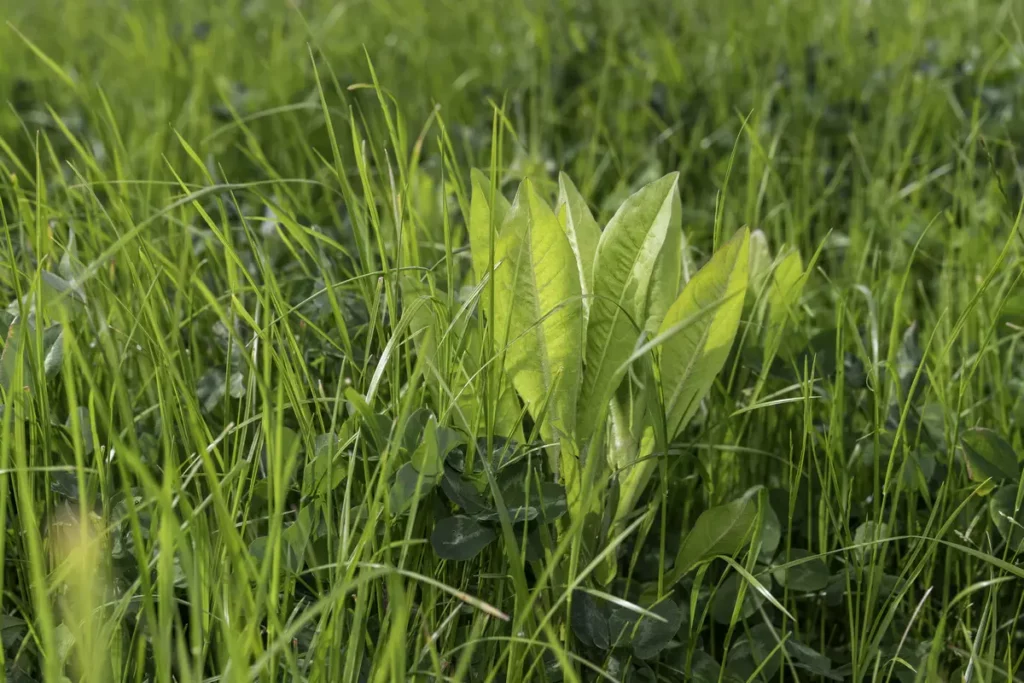
3. How can multi-species swards be used?
Grazing
Multi-species swards can be managed similarly to grass, with slightly longer rotation lengths. Animals will tolerate grazing multi-species swards at a higher pre-grazing mass, compared to perennial ryegrass, without compromising on utilisation.
Rotational grazing will result in better sward quality, utilisation, and persistence compared to set-stocking. Animals should graze out the multi-species paddock in one to three days. This will prevent the selective overgrazing of preferred species.
Allowing the paddock to rest sufficiently between grazings is also important. Allow 25-28 days to help improve the persistency of the herbs and legumes in the sward.
For more on grazing systems, click here.
Silage
While multi-species are generally considered more suitable for grazing, they can be cut for silage if they get too strong. If cutting multi-species swards for silage, remember:
- Maintain a cutting height of around 6cm to protect the crown of the herbs and red clover, as cutting too tight may kill the plants.
- Due to the herb and legume content, they will have a lower dry matter percentage compared to a perennial ryegrass sward, so adequate wilting is essential. Up to 48 hours might be needed.
- Cut in the late morning or early afternoon after the dew has evaporated. This improves the wilt and ensures sugars in the plants and grasses, in particular, are at their peak.
- Avoid using machinery in wet conditions as this will damage the sward and cause soil compaction.
4. Which species can be used?
Multi-species broadly fall under three types: grasses, legumes, and herbs. However, they perform differently and some are more effective than others. Explore the different species and their characteristics below before considering performance in the next section.
The sward types with most research include perennial ryegrass and timothy grasses, with white and red clovers and the herbs chicory and plantain.
| Forage type | Species | Characteristics |
| Grasses | Perennial ryegrass | Spring and autumn growth High in quality |
| Timothy | Suitable for all soils Spring and autumn growth Palatable | |
| Cocksfoot | Suite dry soils Deep rooting | |
| Meadow fescue | Suits all soil types Drought-tolerant Low yielding | |
| Legumes | White clover | Fixes around 150kg N/ha/year High in quality and protein |
| Red clover | Fixes atmospheric nitrogen Yield potential of 10-15t DM/ha/year High in yield, quality, and protein Not recommended as a monoculture due to N leaching | |
| Birdsfoot trefoil | Can reduce methane emissions High in quality and protein Conventional varieties are susceptible to grazing damage | |
| Black medic | Short-lived annual/biennial Suitable for undersowing Improves soil health | |
| Hairy vetch | Vigorous spring growth High in quality and protein forage Suitable for cover cropping | |
| Sainfoin | Drought-tolerant Palatable Anthelmintic properties Needs high pH, free-draining soil Not suitable for heavy grazing | |
| Herbs | Chicory | Deep-rooting Drought-tolerant High in minerals but only when available in soil Anthelmintic properties |
| Plantain | Good early-season growth Coarse root structure Medium root depth Palatable High in minerals | |
| Burnet | Deep rooting Drought-tolerant Easier to establish than other herbs | |
| Sheeps parsley | Deep rooting Drought-tolerant Conditions soil Difficult to establish | |
| Yarrow | Deep-rooting Drought-tolerant Difficult to establish |
5. Maximising performance
There’s growing research to support the forage production and livestock performance potential of using multi-species in dairy, beef, and sheep systems.
Forage production
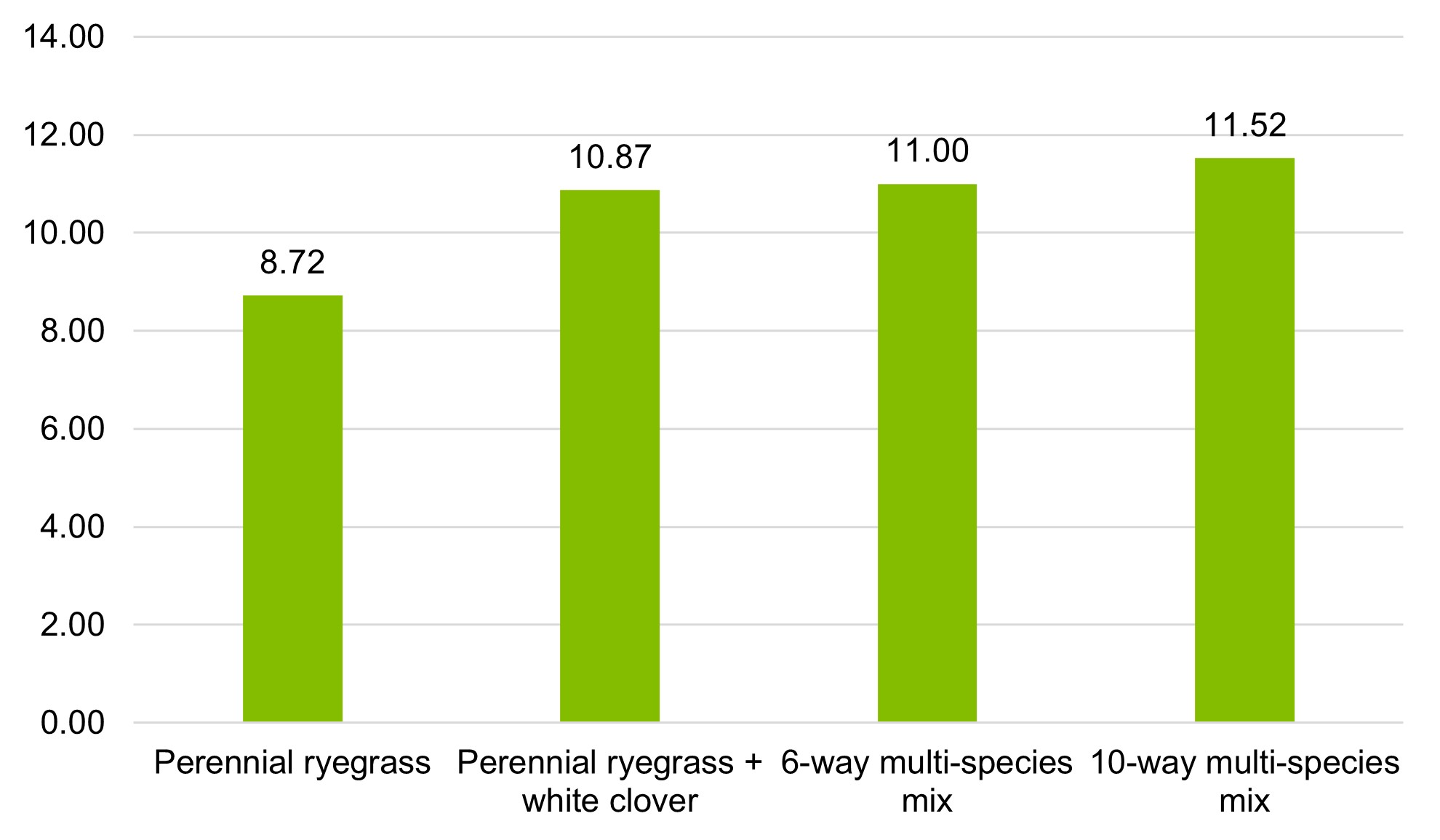
A four-year trial at Germinal Horizon Wiltshire found that multi-species swards outyielded perennial ryegrass-only swards by at least 26% when comparing the average yield per year. Even just diversifying with white clover increased the average annual yield by 25%.
In this trial, the 6-way multi-species mix included perennial ryegrass, timothy, white clover, red clover, plantain and chicory. The 10-way multi-species mix added a further four elements, including alsike clover, black medic, birdsfoot trefoil, and minor herbs.
Average annual yield of different sward types: 2020-2023
Source: Germinal Horizon Wiltshire
Liveweight gain
Multi-species are often used in beef and sheep systems, due to the benefits they bring to young stock. Beaucarne et al (2025) completed a two-year study of co-grazing heifers and lambs on four different sward types, showing the positive impact multi-species grazing can have on sustainable livestock production.
Impact of sward type on production performance of heifers and lambs
| Metric | Perennial ryegrass (170kg N/ha/yr) | Permanent pasture (135kg N/ha/yr) | 6 multi-species (70kg N/ha/yr) | 12 multi-species (70kg N/ha/yr) | |
| Heifers | Grazing days to slaughter | 186.5 | 187.5 | 182.0 | 181.0 |
| Age at slaughter (days) | 582.0 | 576.5 | 570.0 | 575.5 | |
| Liveweight at slaughter (kg) | 517.5 | 509.5 | 538.0 | 525.0 | |
| Lambs | Grazing days to slaughter | 132.5 | 125.5 | 81.5 | 93.0 |
| Age at slaughter (days) | 164.0 | 152.0 | 107.0 | 121.5 | |
| Liveweight at slaughter (kg) | 45.8 | 45.4 | 44.5 | 45.2 |
Source: Beaucarne et al (2025)
Heifers were finished earlier on both multi-species swards, while also registering higher liveweight gain at slaughter. Multi-species were also more cost-effective and sustainable, requiring much less artificial nitrogen.
By comparison, in the lamb grazing trial versus the permanent pasture treatment, lambs were finished 30 days earlier on the 12-species sward and 45 days earlier on the six-species sward.
Dairy potential
While multi-species swards have been more commonly fed in beef and sheep systems, we’ve seen a recent rise in dairy usage. Backed by research, Kostovska et al (2024) shared promising results in the Journal of Dairy Science.
Yearly milk yield and gross composition values
| Holstein-Friesian | Jersey Holstein-Friesian | |||
| Perennial ryegrass | Multi-species | Perennial ryegrass | Multi-species | |
| Yield (kg/cow/day) | 20.6 | 20.7 | 18.8 | 20.0 |
| Fat (%) | 4.3 | 4.8 | 5.0 | 5.0 |
| Protein (%) | 3.7 | 3.8 | 4.0 | 4.0 |
| Total solids (%) | 13.4 | 14.1 | 14.5 | 14.5 |
| Lactose (%) | 4.7 | 4.7 | 4.8 | 4.8 |
Source: Kostovska et al (2024)
The study compared a perennial ryegrass system with high nitrogen applications (250 kg N/ha per year) against multi-species swards with low nitrogen applications (125 kg N/ha per year). And the focus was on grazing Holstein-Friesian and Jersey Holstein-Friesian cows in a spring-calving system.
With Holstein-Friesians, the results showed the potential to increase fat from 4.3% to 4.8% for the year, and total solids from 13.4% to 14.1%. Meanwhile, the Jersey Holstein-Friesians performed better on milk yield, increasing from 18.8kg per cow per year to 20.0kg.
This shows that multi-species swards can support strong dairy production, while letting you lower artificial nitrogen applications to reduce input costs and improve environmental performance.
6. Sowing advice
Considerations
- Control weeds before sowing, as there are no options for spraying after it is sown. Avoid sowing in fields with a history of weed problems
- Using a stale seedbed can reduce the weed burden on the subsequent sward.
- Good soil fertility and correct sowing time are also important.
- Sowing from late April to May with warmer soil temperatures works well. Multi-species swards should not be sown later than mid-August.
- Multi-species mixtures work best in a full reseed. The smaller seeds of some species struggle to establish in existing swards, making them unsuitable for overseeding.
- Early sowing allows better establishment before winter, which is important for root development and long-term persistency.
- Herbs perform better in the mid-season, so it’s important to include perennial ryegrass for consistent forage production across the season.
Sowing methods
- Broadcasting is the most common and effective method of sowing, in a well prepared clean, fine and firm seedbed.
- Direct drilling can be used but allows the more aggressive ryegrass and clovers to dominate and outcompete the slower-establishing species.
- Undersowing can also be used in spring with an early-maturing, lodging-resistant cereal companion crop, drilled at a reduced seed rate (not exceeding 120kg/ha) and harvested as arable silage.
- In rotational systems, preceding crops should be cereals, roots or brassicas, which reduce soil nitrogen levels. This encourages the establishment of the legumes in a multi-species grass seed mixture and will help create a lower weed burden within the field.
Checklist: Sowing multi-species
- Choose fertile fields with pH 6.3 or above, P & K index 3.
- Spray off old sward and remove trash prior to cultivation.
- Apply lime as indicated by soil test results to correct pH. Lime will also help break down the old sward and counteract suface acidity from decaying material.
- Cultivate and roll to create a fine and firm seedbed.
- Sow at the recommended seed rate for the mixture. Go no deeper than 5-10mm, and roll well after sowing. Good soil-to-seed contact is essential for quick and successful establishment
- Apply three bags of 10:10:20.
- Monitor new sward for pests.
7. Managing multi-species swards
Grazing
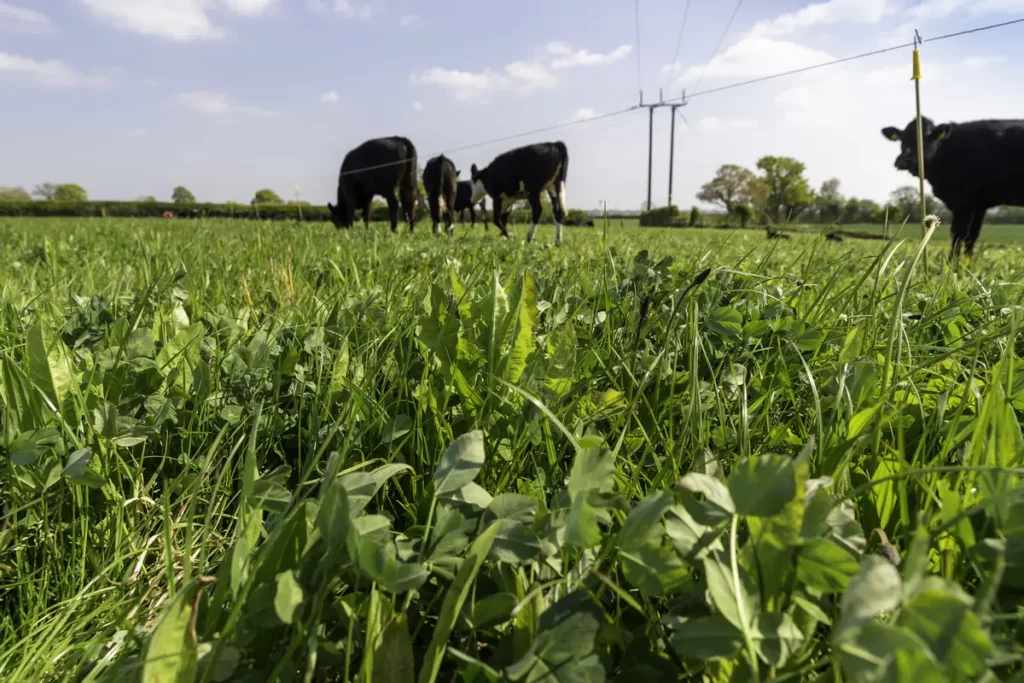
- Early grazing helps promote growth and encourages roots to anchor, but avoid damage and over-grazing.
- Graze approximately eight weeks after sowing, when plants can withstand the pull test.
- This is done by trying to tear off a handful of grass. If the whole plant comes out, the sward needs more time to establish – if just the leaf tears, it’s ready to graze.
- You can also look for when plantain has six true leaves and when perennial chicory has seven true leaves per plant.
- Rotationally graze for best results (e.g. graze 1-3 days, rest 25-30 days).
- Target post-grazing residual of 6cm.
- Avoid hard grazing or grazing under poor ground conditions to protect the herbs and red clover from damage and potential loss of productivity and persistency
Pests and disease control
There are no agrochemical options for the control of pests and diseases, so good management is necessary. Break cropping as part of a rotation is useful. Brassica fodder crops are a good option as a pest and disease break, but also as an additional quality forage.
Common pests include:
- Slugs: particularly troublesome in drilled crops.
- Stem eelworm: distorts buds and young leaves.
- Sitona weevil: more common in areas close to arable crops.
- Leatherjackets: check for damage after ploughing old pastures.
Bloat risk
Bloat is the excessive build-up of gas (carbon dioxide and methane) in the rumen, produced by the rapid breakdown of clover protein. This causes distress and possible death due to the exertion of pressure on the animal’s diaphragm, heart, and lungs.
Legumes can present an increased bloat risk in cattle. While the risk is always present in high clover swards, and further heightened in late summer and early autumn on damp days, you can minimise the risks of bloat by adopting these best practices:
- Limiting access to swards when stock is first introduced (e.g. have a breakfast break).
- Avoiding turnout of hungry stock.
- Feeding high dry matter forage such as hay/straw prior to turnout.
- Offering hay/straw at intervals (e.g. to dairy cows at milking times).
- Feeding an anti-bloat feed additive.
- Monitoring livestock
Boost soil and stock
Want to do more with multi-species? You can find mixture options in our Climate Smart Thrive range. Offering performance plus sustainability, these mixtures have been expertly formulated to give you the best of both, with no compromise on production.
Share article